Burgfest Tangermünde
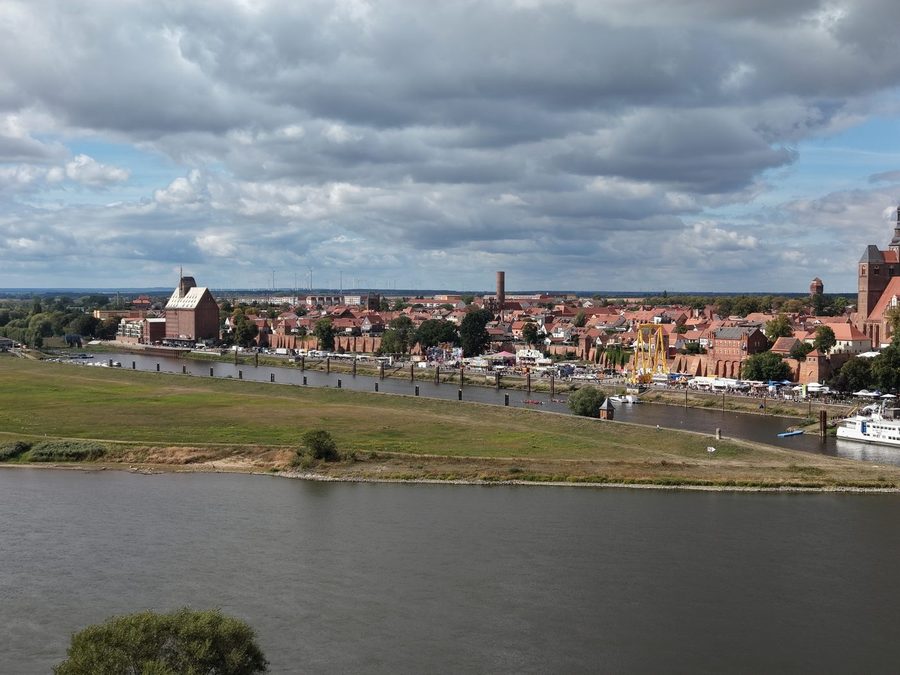
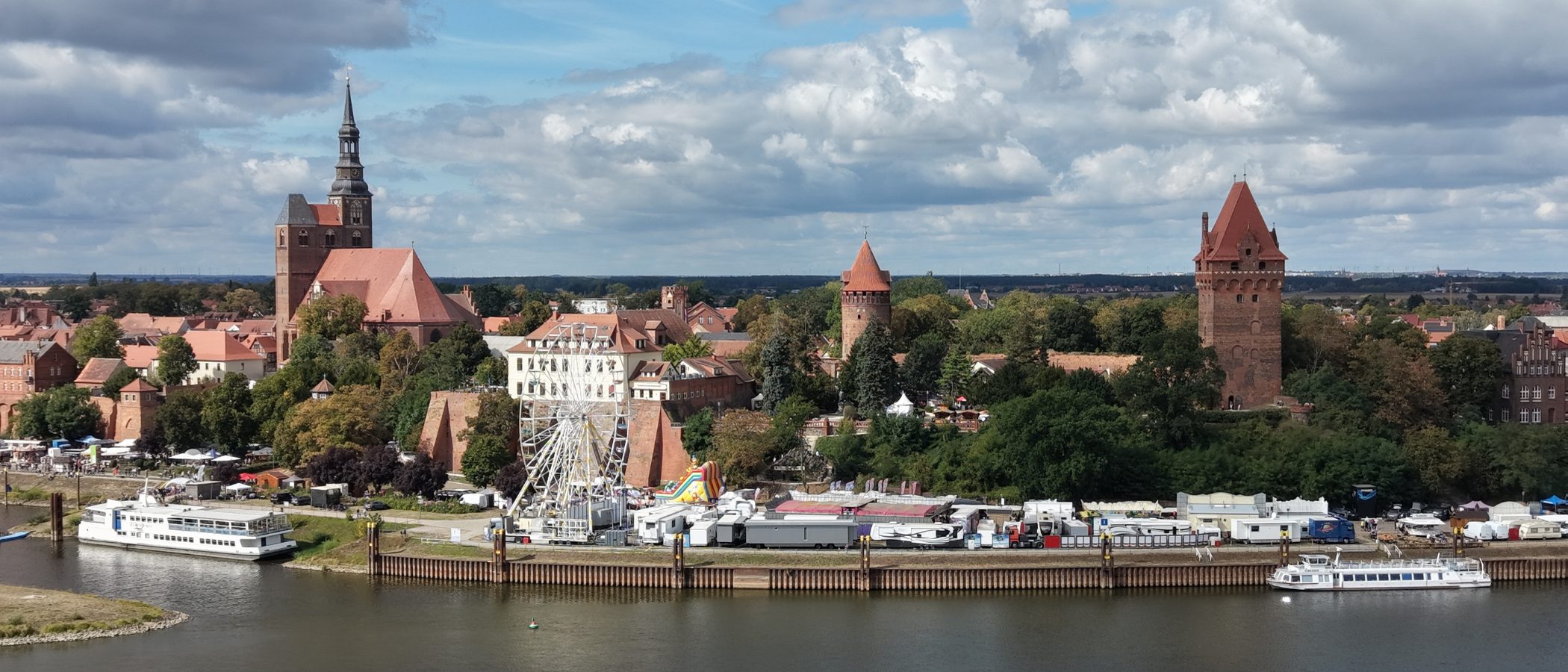
The Elbe in front, the festival meadow at the harbour, castle and St Stephen’s behind.
On the second weekend in September Tangermünde belongs for three days to the emperor, the fairground and the Elbe. Friday evening the festival opens, Saturday Charles IV and his retinue pass through the Neustädter Tor up to the castle, Sunday the court stays open for families. From Havelberg it is just under 40 kilometres, a good half hour by car.
The festival sits in three places at once. Up on the castle hill, the medieval market. In the old town, stages, lanes and the procession. Down at the harbour, the fair, boats and on Saturday evening fireworks over the river. If you only have one afternoon, take Saturday. If you stay the night, Friday evening and Sunday morning come free with it.
The festival
The first Burgfest took place in 1987, still in GDR times, when industry stood in Tangermünde and the old town was waiting to be restored. The count has not broken since. 2018 was the 31st, 2023 the 34th, 2025 the 36th festival. It is the great town festival of the Altmark, not a generic market with a historic wash. The procession restages a dated event: the entry of Emperor Charles IV on 7 September 1373.
The weekend is organised jointly. The town looks after the historic core between Neustädter Tor, Eulenturm and the castle hill. An events company from Rostock takes the harbour, the Elbe bank and the large meadow at Bleichenberg. Houses such as Schulzens add their own programme in the Elbe garden. Each year there is a new programme booklet. The fixed points stay the same, bands and stallholders change. The emperor always comes.
Friday
Friday evening the festival opens, at the stage by the town hall and market. Music, a short fire display, then the stage programme runs into the night. For children there is the lantern procession, accompanied by a fanfare corps, the march heading towards the harbour. If you come with children, plan Friday in. If you only want a drink and something to listen to, stay at the market.
Saturday
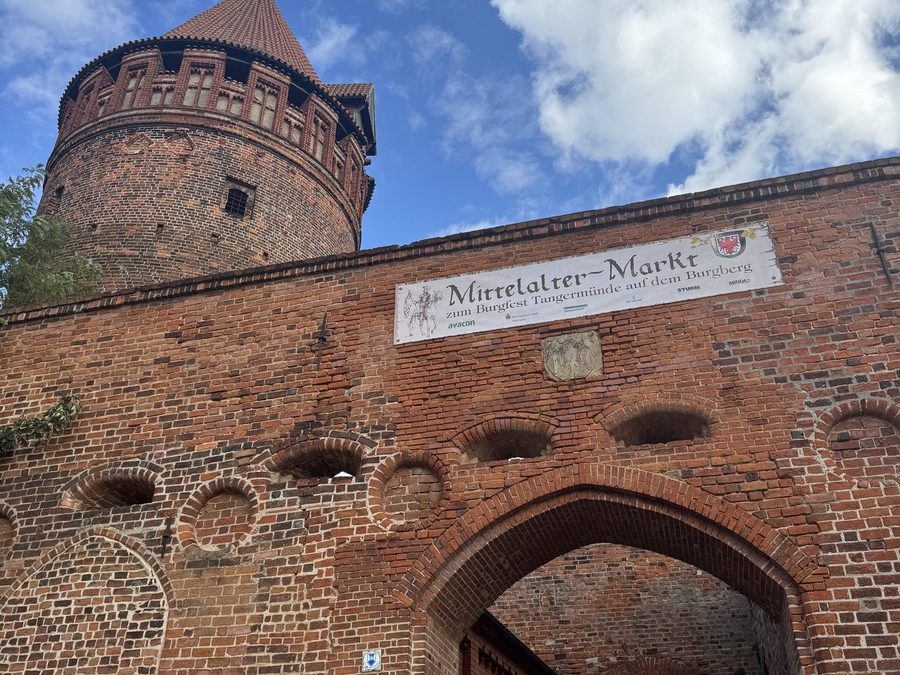
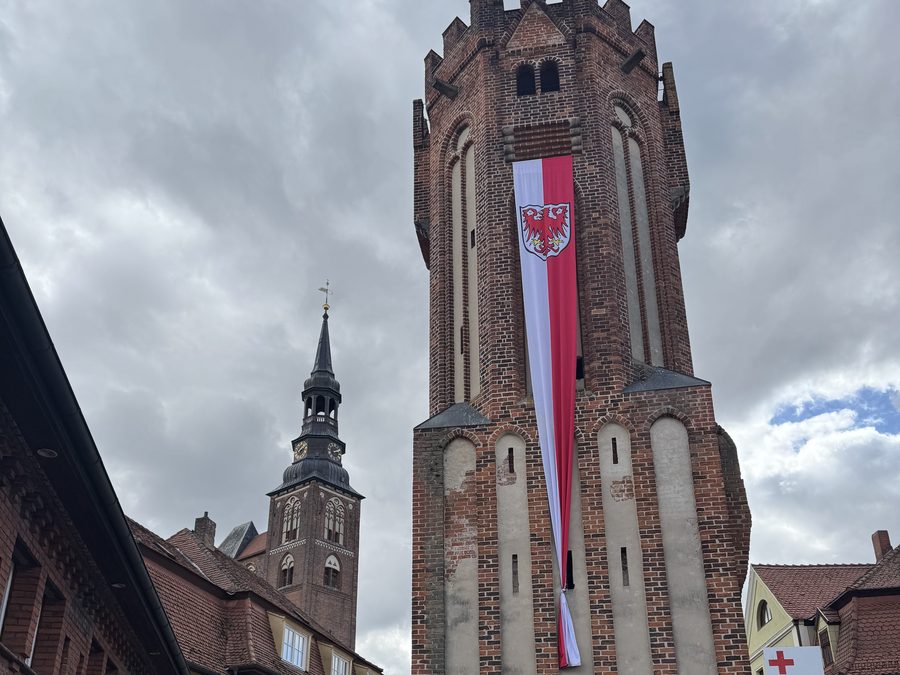
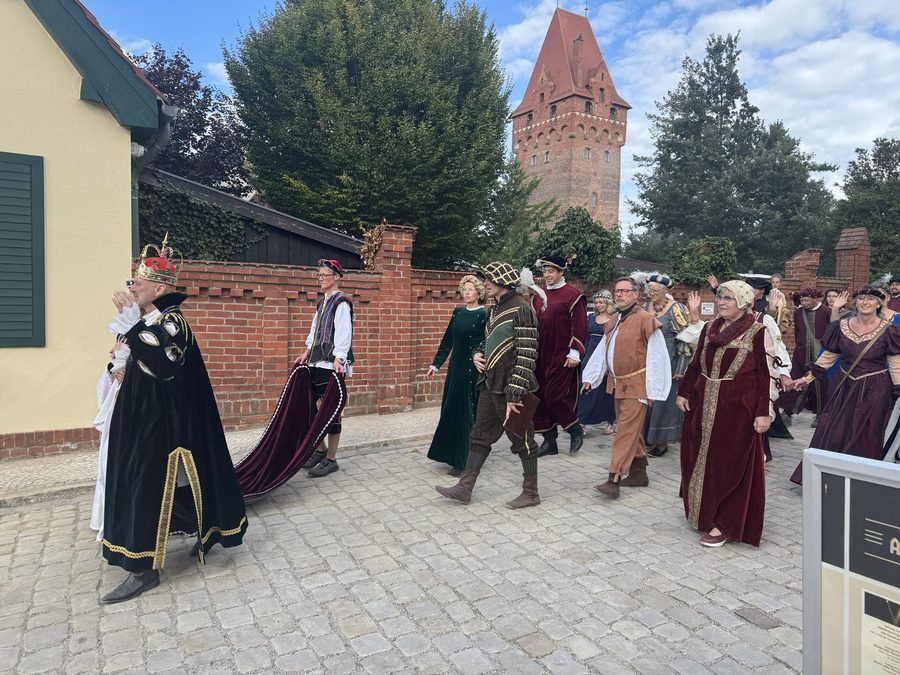
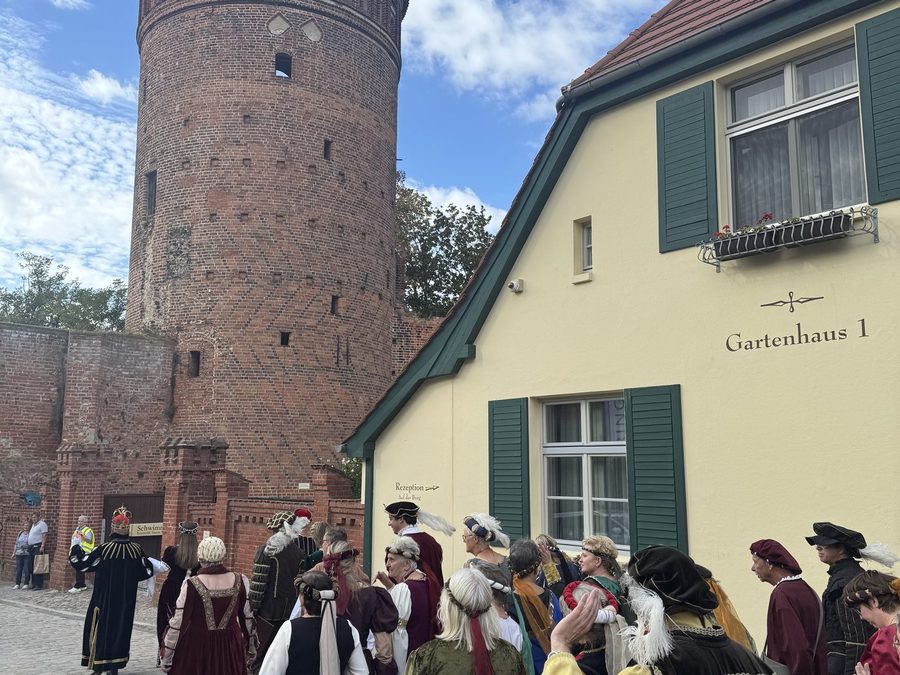
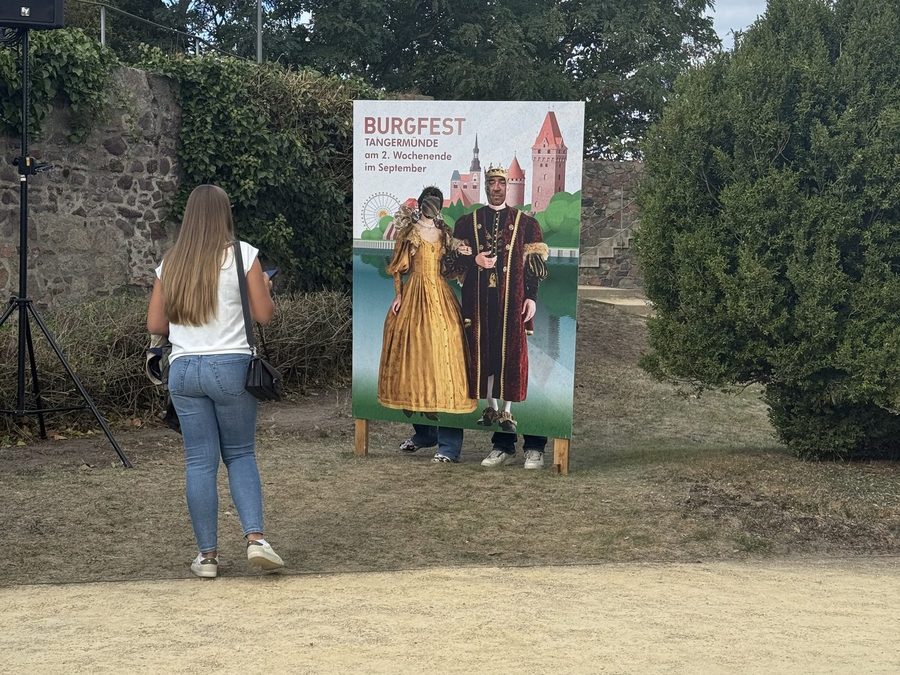
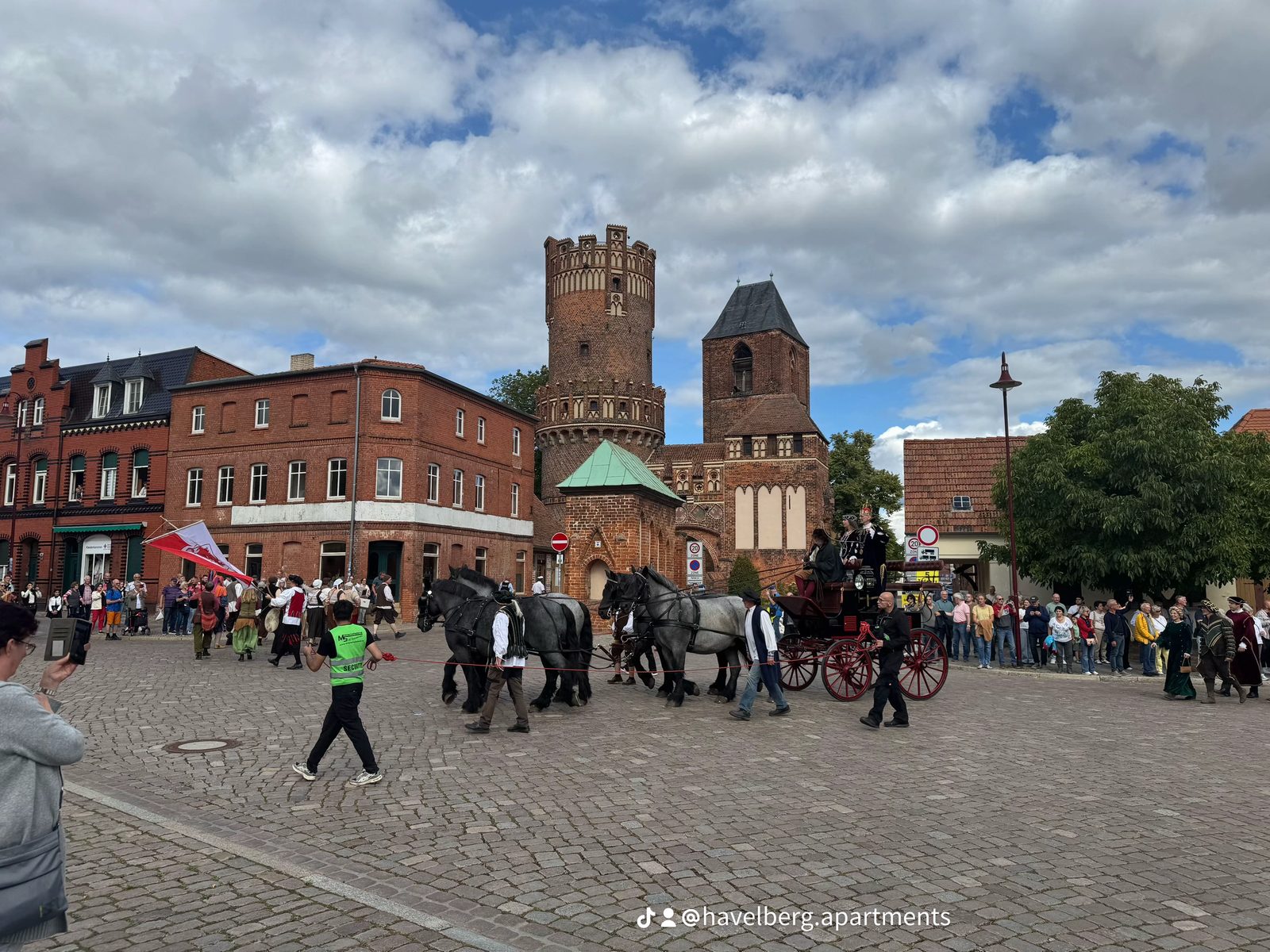
Saturday is the big day. In the afternoon, around 3 pm, the historic procession sets off. Emperor Charles IV and his consort Elisabeth of Pomerania, in recent years played by Rüdiger Albrecht and Anne Birkholz, walk with the court through the Neustädter Tor and up through the town to the castle. At the top the emperor addresses his people. After that the castle courtyard stays full. Down on the Elbe a dragon-boat race has taken hold in some years. The visual close is the high fireworks over the water.
If you want to photograph the procession, stand at the Neustädter Tor, not only up at the castle. The passage is narrow, the column needs room, and you stand in the middle of it rather than at the edge.
“Milkauer Schalmeien” in front of the Neustädter Tor just before the emperor enters. The best marching music on the ground!
Sunday
Sunday is the quieter day. A family programme on the meadow at Bleichenberg, the medieval market on the castle hill still running. If you stayed on Saturday night for the fireworks, Sunday morning the lanes are almost yours. The stalls are there, the noise is smaller.
The three places
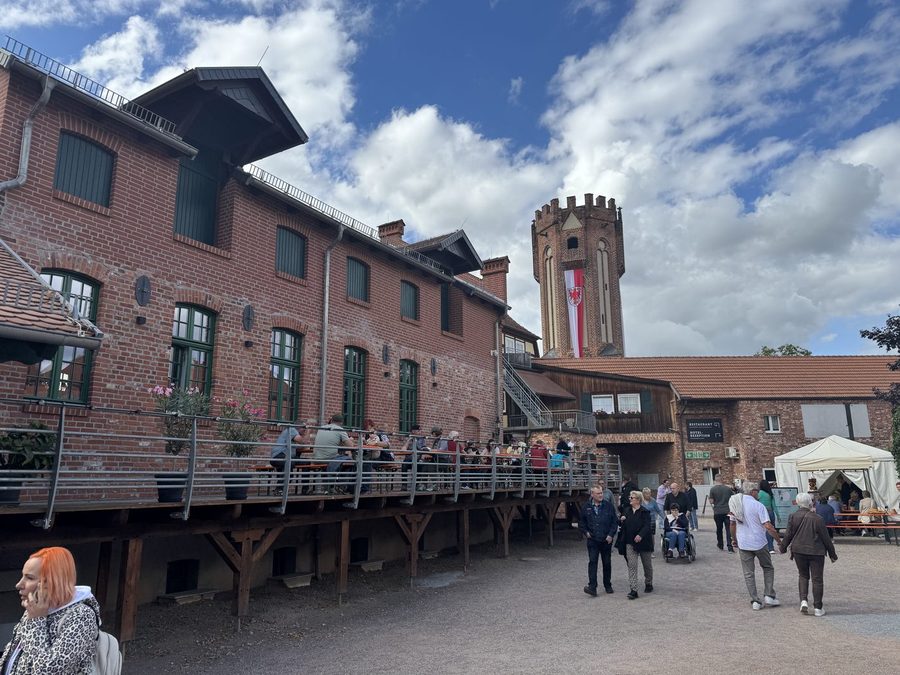
On the castle hill stalls, camp life and costume stand all weekend. A smith, bow and crossbow shooting, wooden games, musicians with a harp. Now and then a rebuilt historic Ferris wheel. This is the part you can walk with children and without watching the clock.
In the old town sit the stages, the food and the route of the procession. Cobbles, narrow passages, timber frames. Proper shoes. The inner town is closed to through traffic. Parking lies outside, then you walk.
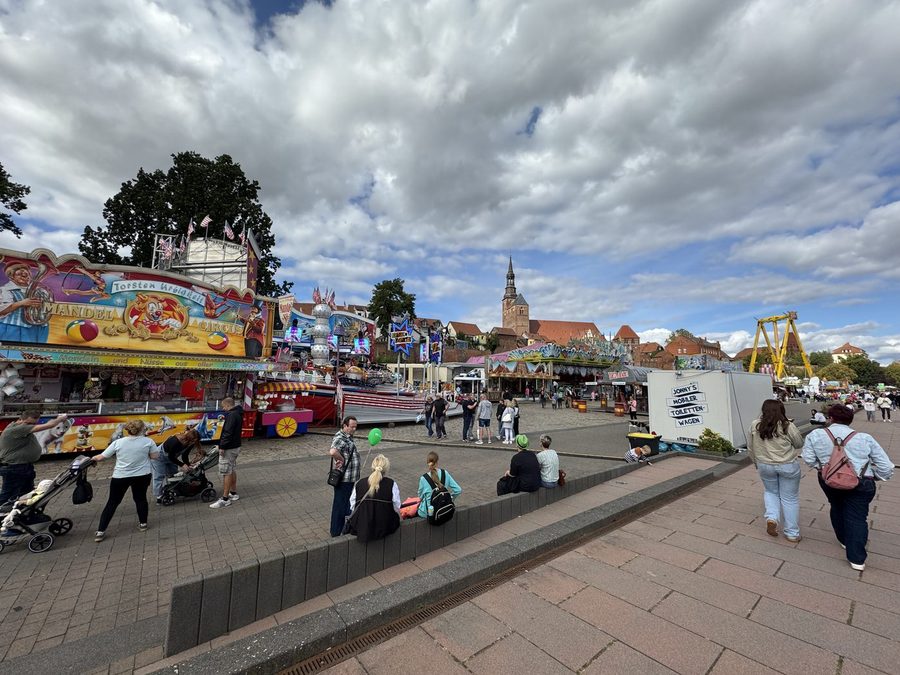
On the Elbe bank and at the harbour stands the fair. Ferris wheel, stalls, boats at the quay. From here you see the town wall and the towers in one line. Saturday evening the spot is worth extra, because the fireworks stand over the Elbe, not somewhere behind a block.
Details of the timetable come from the tourist office at Markt 2, telephone 039322 22393, and from the town of Tangermünde. Individual items can shift. The frame stays: Friday opening, Saturday procession and fireworks, Sunday close.
From Havelberg you come on the country road towards Schönhausen and then along the Elbe, or via Stendal. By train you travel via Stendal to Tangermünde. If you stay the night, leave the car and walk.
Take water with you until you reach the stalls. The castle hill has little shade when the sun is up. A light rain jacket is wiser than an umbrella in the crush. If you want the front of the procession, be at the gate half an hour before it starts. If you have children with you, split the day: morning on the castle hill and at the crafts, afternoon the procession, evening either fireworks or an early night.
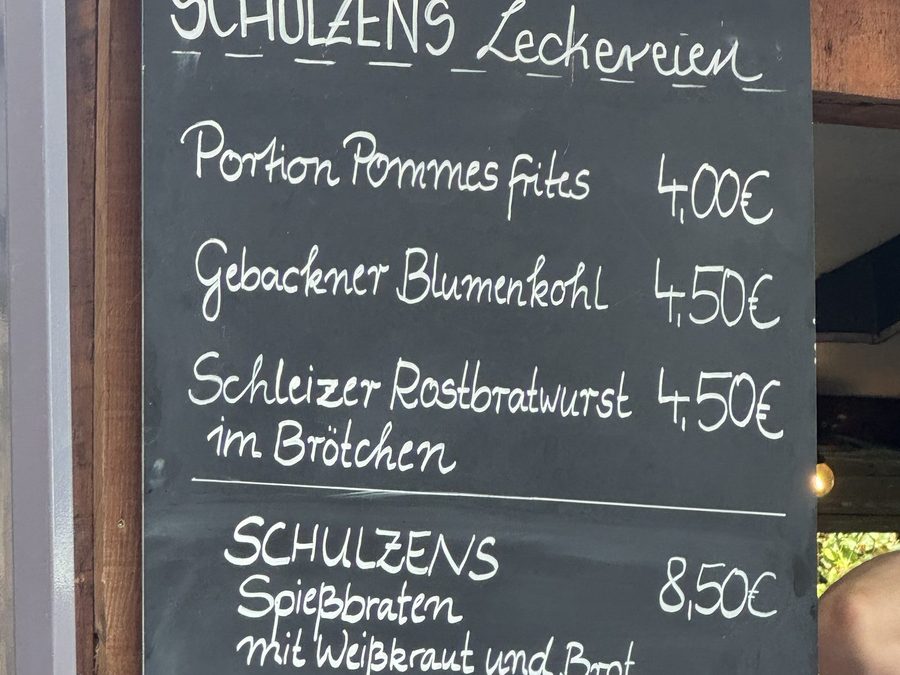
There is food at all three places. Up at the castle courtyard the hotel terrace, in the old town the inns, at the harbour the stalls. Schulzens sets an extra table in the Elbe garden. Prices and dishes change. Hunger after the procession is not a planning error. It is part of Saturday.
The festival likes to sit next to town anniversaries. In 2009 the 22nd Burgfest fell on 1,000 years since the first mention. A neat sum from the town: 1009 plus 1009 makes 2018, and in that year a large procession walked the streets again. In 2023 the 650th year since Charles’s entry sat beside it. You do not need to learn the figures. It is enough to know the weekend was not invented from thin air.
Tangermünde
Tangermünde lies in the Altmark, district of Stendal, on a terminal moraine above the left bank of the Elbe. The Tanger joins the river here. The raised site historically kept the town above flood water and made the Elbe toll possible. Around 10,000 inhabitants, a member of the European Route of Brick Gothic, often named among the most beautiful small towns in Germany. Twin towns include Lich, Minden, Tavarnelle Val di Pesa and Wissembourg.
From Havelberg the town is an outing with a clear reward: you swap the island for a hillside, the cathedral for St Stephen and the Kapitelturm, the town moat for the open Elbe. If you sleep in Havelberg on the Burgfest weekend and only drive across, you have the town island in the morning and the emperor’s procession in the afternoon.
The old town is small enough to walk in a day, and large enough to lose yourself between gate, market, church and castle. Lange Straße, Kirchstraße, Schlossfreiheit: the names already tell you where you stand. The Roßpforte sits near the Schlafstuben, the Eulenturm beside Schulzens, the Neustädter Tor at the start of the procession. If you have an hour without a programme, walk the wall and look out over the meadows.
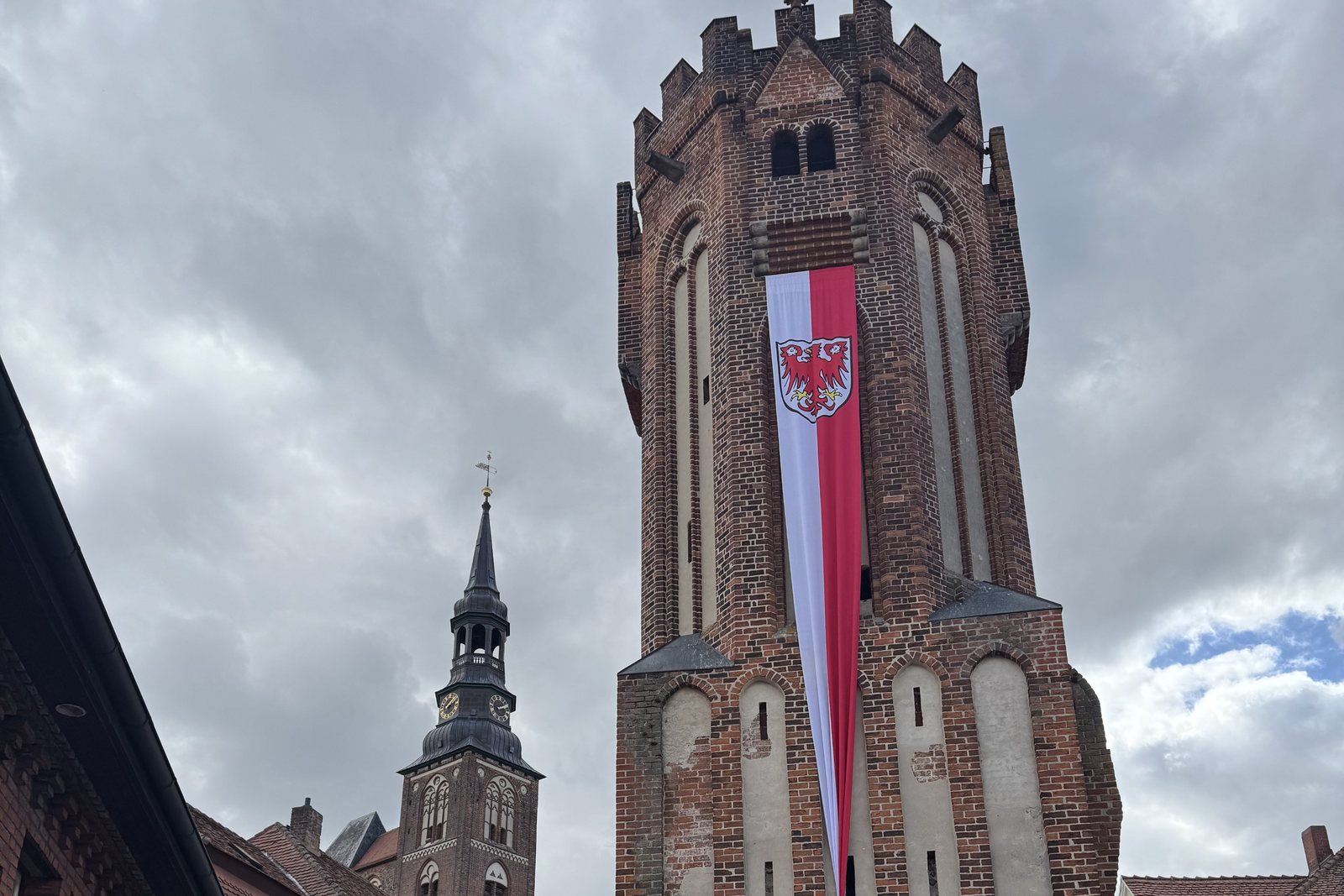
Tangermünde has been a film set more than once, among other things for television crime films by Werner Toelcke and in 1973 for the DEFA film Rotfuchs. That is why the backdrop looks finished: towers, gables, cobbles, the Elbe slope. On the festival weekend only the emperor is added.
Elbe levels belong to the town as much as the towers. The highest measured stand at Tangermünde was 7.68 metres on 20 August 2002. The moraine historically protected the core. Down at the harbour you still see how close the river sits to the stalls. The new Elbe bridge of 1997 to 2001 spans 185 metres, 1,800 tonnes of steel, and brings you back into the Altmark from the other bank.
Town hall
The oldest part of the town hall is the east wing of 1430, probably by the master builder Hinrich Brunsberg. Its mark is the 24-metre late Gothic brick show front, one of the strong civic buildings of North German Brick Gothic. Behind it lies the festival hall with a star-ribbed vault. In 1480 the court porch was added, above it the council chamber, today the wedding room. The original medieval town hall burned in 1617. What you see was first an extension, later an addition after plans by Friedrich August Stüler. On the ground floor sits the town history museum, among other things the Grete Minde exhibition and ship models of the Elbe. White storks nest regularly on the roof. The house keeps working even when there is no festival.
St. Stephan
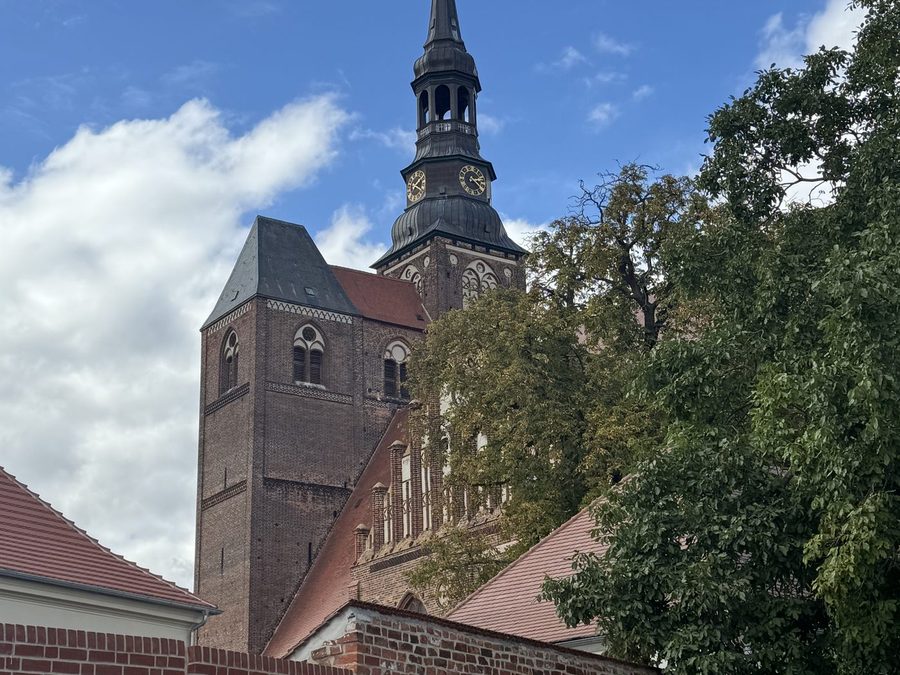
St Stephen’s is a Gothic hall church that grew out of a Romanesque basilica of the twelfth century. The north tower measures 87 metres and is the tallest of Tangermünde’s twelve towers, the tallest church tower in the Altmark. The baroque cap replaced the fire of 1617 and was last restored around the turn of the millennium.
After the town fire Tangermünde could not afford a new organ. Hamburg stepped in and commissioned Hans Scherer the Younger. Board and lodging for the organ builder and his journeymen were paid by the town. The instrument was consecrated in 1624. Around half the pipes are original. The case resembles the Scherer organ in St Giles’s in Lübeck. A bronze font of 1508. Almost the entire medieval fittings were lost in 1617.
Behind the high altar stands an astronomical clock, built by the Tangermünde engineer Volker Schulz together with Thomas Leu. If on the festival weekend you only see towers and a procession, here is a quiet reason to come back to Tangermünde a second time.
The castle
The castle sits on the moraine above the river. First mention in 1009 by Thietmar of Merseburg as civitate Tongeremuthi. The town itself is documented in 1275. From 1373 to 1378 the complex was a secondary residence of Emperor Charles IV beside the Hradčany in Prague. He had it enlarged and wanted Tangermünde as capital of the middle provinces.
The Kapitelturm is a residential tower about 50 metres high from the fourteenth century, six storeys. It takes its name because from the sixteenth to the nineteenth century it served as a grain store for the revenues of the Berlin cathedral chapter. The top storey was rebuilt in 1903 under Wilhelm II after a copperplate by Matthäus Merian. Since 2003, after restoration, the tower has been open as a lookout.
The Alte Kanzlei is the only building of the castle still standing from the fourteenth century. Originally Charles IV’s dance house for court festivals, only after the Thirty Years’ War a castle chancery, hence the sober name. The prison tower was built around 1480 under Elector Albrecht Achilles, secured the approach to the castle and carries zigzag bands of dark glazed brick on the outside. On the ground floor lay a dungeon with walls 3.50 metres thick, originally reached only from above. Three storeys with spherical vaults, at the top a platform with a ring of battlements. The conical roof came in 1902, the tower measures 37 metres. It only received the name prison when cells were built in the mid-eighteenth century.
Charles IV’s own palace was destroyed in the Thirty Years’ War. The present baroque building went up from 1699 to 1701 under the first Prussian king, Frederick I, as a stopping place. Two bronze monuments stand on the grounds: Emperor Charles IV of 1900, a gift of Wilhelm II, a copy of a statue from Berlin’s Siegesallee by Ludwig Cauer, and Elector Frederick I of 1912, sculptor Ludwig Manzel.
One anecdote sticks. On 21 June 1841 King Frederick William IV visited the castle with Queen Elisabeth and Prince Charles. During the festivities the stone railing of the castle bridge gave way. Several people fell into the castle ditch. The king had a large sum paid to the injured. The bridge holds today.
History
Three years carry the visit: 1373, 1617, 1987. Between them sits a Hanseatic town that was a residence, a toll town, a fire victim and later an industrial town. Each year the Burgfest takes the same entrance from that story.
Charles IV and the residence
Charles was born in Prague on 14 May 1316 as Wenceslaus of Luxembourg, son of King John of Bohemia. He took the name Charles after Charlemagne. From 1347 King of the Romans, from 1355 emperor, and at the same time King of Bohemia. He made Prague the Golden City, founded in 1348 the first university in Central Europe, and had St Vitus’s Cathedral continued. In 1356 he issued the Golden Bull, until 1806 the basic law of the royal election.
In 1373 he acquired the Margraviate of Brandenburg for his sons and made Tangermünde a secondary residence. The Elbe trade route and the existing castle explain the choice better than any legend. In 1375 he had the places of the March recorded in the Brandenburg land book, a source many town anniversaries still rest on. On 29 November 1378 he died in Prague. With his death Tangermünde’s time as an imperial residence largely ended.
After Charles came restless years under Sigismund and Jobst of Moravia. In 1415 the Hohenzollerns took the electorate. Frederick I received the castle as a residence. The fifteenth century became the bloom as a Hanseatic town: salt, cloth, timber, beer. In that period the town hall, the gates and the Gothic enlargement of St Stephen’s go up. In 1488 a citizens’ rising against a beer tax. Elector Johann Cicero lost faith in the town. The residence moved to Berlin, Tangermünde became an administrative centre of the Altmark and the Prignitz instead of a court.
The fire and Grete Minde
On 13 September 1617 the town burned. Between two thirds and three quarters of the more than 600 houses were lost; 486 dwellings and 52 barns were counted. Stone buildings such as the town hall and St Stephen’s survived badly damaged. In 1619 Margarethe von Minden, later called Grete Minde, was executed as the supposed arsonist. Her father had left the town after a suspicion of manslaughter. She fought for her inheritance and in 1616 married the penniless Tönnies Meilahn. Two years after the fire she came under suspicion after her husband accused her under torture. The court treated her guilt as proven.
In 1880 Theodor Fontane worked the case into the novella Grete Minde, researched on the spot in 1878, with clear departures from the files. In 1883 the lawyer Ludolf Parisius found contradictions in the trial records. Today it is widely accepted that Grete Minde was ill in Apenburg at the time of the fire and died innocent. A fire inscription of 1617 on the house at Kirchstraße 23 still marks it, as does the exhibition in the museum. The seventeenth century also brought the Thirty Years’ War and the plague. The trading bloom was over.
At Schlossfreiheit 3, the former electoral Elbe toll house, a plaque tells the same layer the other way round: two predecessor houses fell to the fire of 1678, cellars survive. One house belonged to the von Minden family, Hans von Minden was Tangervogt in the sixteenth century. His great-granddaughter Grete was sentenced in 1619. The second house was a fief of the Gunz family. After 1678 the present timber-framed house with a solid facade went up, until 1791 the Elbe toll office, later in private hands, often with bargemen and craftsmen. Since 1991 a gallery has sat there.
From industrial town to festival
In the GDR industry shaped the town. In 1987, still before the Wende, Tangermünde founded the Burgfest and reached back to the medieval bloom, long before the old town was restored. After 1990 the works fell away. The other side of that break was the restoration of lanes, towers and courtyards. From 1997 to 2001 the new Elbe bridge went up, 185 metres of arch span. In 2003 the Kapitelturm opened as a lookout. In 2009 the 22nd Burgfest fell together with the 1,000-year celebration of the first mention. In 2023, at the 34th festival, the 650th year since Charles’s entry sat beside it. The festival loads itself with real dates, not a motto from a drawer.
That is why the procession, the castle hill and the Neustädter Tor do not stand where they stand by chance. The emperor comes through the same gate. The speech falls in the castle courtyard. The fair lies outside the walls, on the meadow at Bleichenberg and at the harbour, where a town has always put its festival when the stone inside grows too tight.
If you stay in town after the festival, you have the same walk without the crush. Museum in the town hall, climb the Kapitelturm, the organ in St Stephen’s when it is being played. The plaque at the prison tower and the plaque at the Elbe toll house are enough as a pause between two courtyards. The afternoon needs no more.
Havelberg and Tangermünde share the Elbe and Brick Gothic, not the same character. Havelberg is island and cathedral chapter. Tangermünde is hillside, toll and imperial residence. On the second weekend in September both are worth it one after the other. Saturday the procession, Sunday the town island, or the other way round, depending on where the bed stands. If you have more time, arrive a week earlier and take in the Havelberg horse market.
Places to stay
On the festival weekend Tangermünde is full. Three houses sit in the core and can be booked through Booking. If you sleep in Havelberg and only drive across, you find beds under places to stay in Havelberg. The booking links run through our partner programme to Booking.com.
Hotel Schloss Tangermünde
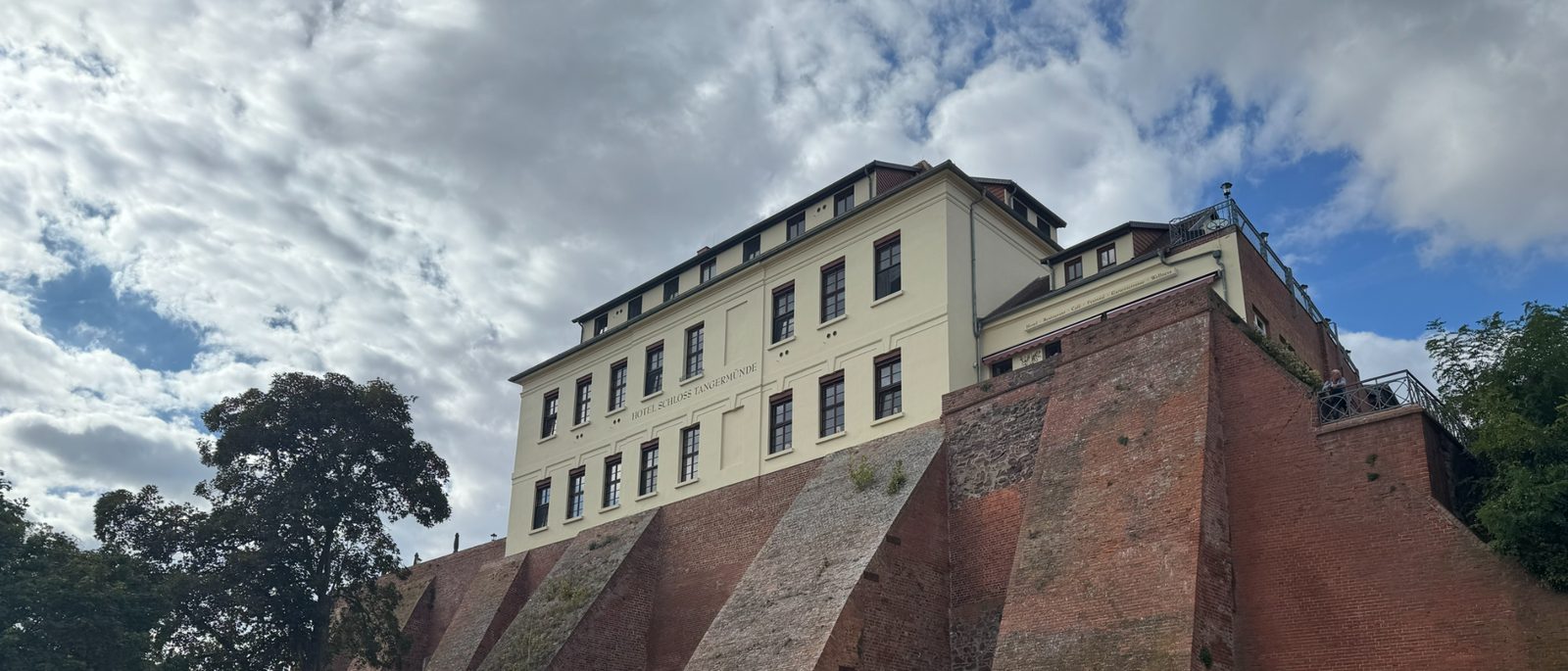
Amt 1, on the historic castle grounds. A view of the Elbe and the old town on one side, the Elbe meadows on the other. The present main house Amt I went up from 1699 to 1701 as a stopping place for Frederick I. In GDR times it was a children’s hospital. In 1999 Melanie Busse bought the building, in 2000 the hotel opened. In 2005 Amt II with the Kaisertherme spa arrived, in 2009 the Königin Luise house as a conference venue with a festival hall.
Alte Kanzlei, Kapitelturm and the prison tower belong to the grounds, the castle courtyard serves as a terrace. Restaurant 1699 carries the building year in its name, the Kaiserterrasse looks onto the river. From here you are two minutes from the medieval market. If you want the fireworks from above, take a room facing the Elbe.
Exempel Schlafstuben
Lange Straße 24, opposite the west front of St Stephen’s, in the middle of the old town. Eighteen theme rooms, each a different chapter. Beside them the Quartier Langer Hals, formerly Hof Hohenstein, with standard rooms and two further theme rooms. Run by the team around Tiemo Schönwald.
In the Kaiser-Karl chamber stands a four-poster with turned posts, beside it a wooden soaking tub. Grete Minde’s burnt ruin shows charred walls and soot-black beams. Winsel’s torture chamber plays the early thirteenth century. Wallenstein’s camp lays you on field beds of willow wood. Then the Princess Feodora chamber and the sleeping room of Jungfer Emerentia Lorenz, after the legend of the stag that saved the girl. If you want to keep the procession in your head, you sleep afterwards in a room that tells the same story.
The Exempel dining rooms cook regional food at midday and in the evening. The Zeitzauber arrangement adds breakfast and dinner. Reception around the clock, a house shop, a bar, an e-bike charging point. To the Eulenturm it is 200 metres, to the Elbe promenade under a kilometre.
Schulzens Brauerei und Hotel
Lange Straße 34, right by the Eulenturm. One of the last farmer-citizen and brewery courtyards in the old town. At the front on the street once sat the cowshed, beside it rooms for maids and farmhands. The brewery building had stood empty since 1917. In 2017, exactly 100 years later, Christian and Armin Schulz began brewing beer again, first as contract brewing to their own recipe, later on their own plant.
The beers are called Helles, Ziegelrot in the colour of the brick, and a strong porter that also goes into the spent-grain bread. The house has 42 beds, a restaurant with 60 seats, a beer garden with a view of the Elbe, a glass-fronted show brewery, a barn exhibition of the old craft and a cabinet of curiosities. Popular is the arrangement Three Days Tangermünde including an Elbe boat trip. On the festival weekend something extra often stands on the table in the Elbe garden.
Pictures from the festival
Gate, procession, castle courtyard, harbour, table.